Firefighter Quest
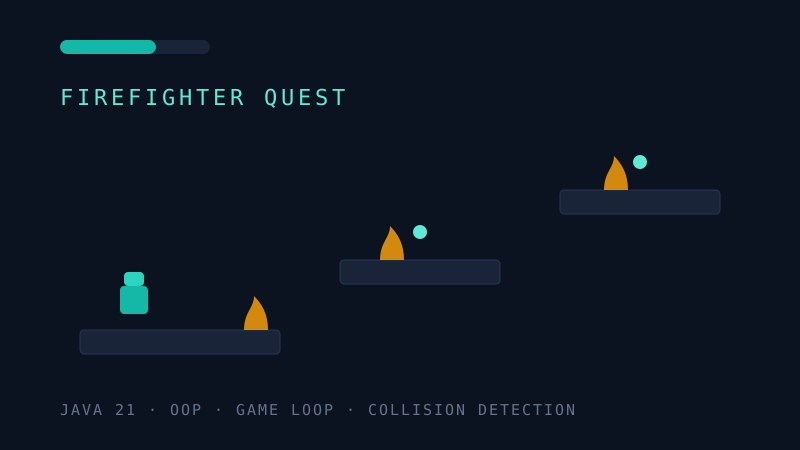
A 2D Java game with player physics, multiple enemy and hazard types, collectibles and a full HUD — built on object-oriented design and a custom game loop.
Technology stack
- Java
- Java 21
- OOP
- Game loop
- Collision detection
My role
Designed and implemented the game systems — entities, physics, collisions, health and HUD.
Key features
- Player movement and physics
- Multiple enemy types with distinct behaviour
- Traps and environmental hazards
- Collectible items and health system
- Collision detection and response
- HUD showing player status
Overview
Firefighter Quest is a 2D Java game where the player navigates hazardous levels, avoiding enemies and traps while collecting items and managing health. It was built from the ground up in Java 21 — no game engine — which meant implementing the game loop, physics, collision handling and UI directly.
Goals
- Build a complete, playable game using object-oriented design
- Implement core game architecture — loop, entities, physics, collisions — by hand
- Support multiple enemy and hazard types without duplicated code
How it works
The game runs on a loop that updates entity state and renders each frame. Entities — the player, enemies, traps, collectibles — share a common base class and override behaviour where they differ, so adding a new enemy type means adding one class, not touching the loop. Collision detection resolves interactions between the player and the world: taking damage from hazards, picking up items, blocking movement against solid objects. A HUD tracks health and collected items.
Decisions and trade-offs
- No engine: using plain Java meant more upfront work but a much deeper understanding of what engines actually do.
- Entity base class + polymorphism: the classic OOP approach fit naturally here and kept the update loop free of type-checking special cases.
- Simple collision shapes: axis-aligned bounding boxes were accurate enough for the gameplay and kept collision code fast and debuggable.
Lessons learned
Real-time systems fail differently from request/response code — bugs are often about ordering and timing rather than wrong logic. Building the loop, physics and collisions by hand made concepts like frame-rate independence and update/render separation concrete instead of theoretical.
Future improvements
- Sound effects and music
- Additional levels and a level-loading format
- Gamepad support
Technical challenges
- Designing a class hierarchy that keeps enemy and hazard behaviour extensible
- Getting collision detection reliable at game-loop speeds
- Tuning movement and physics so the game feels responsive
What I learned
- How a fixed game loop separates update logic from rendering
- Using inheritance and polymorphism where they genuinely simplify entity code
- Debugging real-time behaviour that unit tests don't easily capture